18 June 2012

A Saturday in the Herne Hill Velodrome

We've posted here about our first visit to the mythic Herne Hill Velodrome in South London. Back then I had developed a sore knee and could not even cycle to the venue, but promised myself I would be back to have a go at it. Not that I am so much into racing these days (I was when I was younger!) but it's always interesting to try out new disciplines.

Saturday 9th of June. Weather had been pretty rubbish since we made our return journey from El Camino. No planned rides for the day, the weather seemed to be behaving (for once!) and it looked like the perfect day to take myself down to the Velodrome.

Rode from home the 15 km to the venue, and turned up minutes before the start of the induction for people that had never been on a velodrome. For £8 you get a track bike (a proper fixie these days) and tuition for 1 hour. Not too bad.

The day, although relatively warm to cycle in shorts and short sleeves, turned out to be quite windy. Later on I read that it was gusting up a to 45 mph (close to 75 km/h). The coaches confirmed that it was far from ideal, and that we would have a hard-ish time battling with the wind.

A veteran track cyclists told us about the main rules when cycling in a velodrome: always look for other riders behind you, look ahead of you beyond the rider just in front, and remember that the velodrome is a like a highway. Always look before entering it. A crash at 50 km/h with an oncoming cyclists would be painful. He also insisted on how easy it was to ride a fixed wheel bike. My experience with this is very limited, and I still think they're non-sense for environments other than the velodrome. For the un-initiated, your pedals are fixed to the back wheel, so if the bike is rolling your pedals are rolling. They don't have brakes and the only way to stop is by playing with the pedals. You obviously cannot come to a sudden stop easily. But everyone is in the same situation once in the velodrome, so it's actually ok. 

My bike for the day, a steel Fuji
After that, we entered the tarmac. While holding on to the railings, both feet clipped in, another instructor explained the first exercise. Just go round, one lap, keeping two bikes distance to the rider ahead of you. Get a feeling on the fixed wheel. Brake with the pedals. Do not let go of the handlebars. Seems pretty easy, doesn't it?

On to the next task. We would go for two laps, over two of the different sections of the tarmac. The white ring, closer to the bottom, is meant for people riding fast. The blue, for people rolling a bit slower, and the top for the slowest of riders. We would need to keep the distance with the rider in front of us and also keep to the white and blue lines. This time the instructors seem to accelerate/decelerate more frequently so as to make us get used to the braking with the back wheel. Mind you, sometimes I thought I was going to eat the rider ahead of me, and it was a little tough of my knees. But I managed. And these sorts of sudden decelerations should not happen often in the track. I also think I was too focused on the rider in front of me and not in the ones beyond, which was one of the mistakes of the un-initiated.

We then took a break and split the group (about 20 of us) into fast and slow riders. I still was not fully confident with the bike, so went for the slow group. Slip streaming was the next task. It is well known by cyclists that the one in the front of the bunch does all the hard work breaking into the wind. This exercise would teach us how to share this task in a group, without crashing. The most important thing. Look right before leaving the front. Slow down and let yourself fall back on to the back of the group. Upon looking right, you stick your right elbow out to indicate your move to the following rider. You then are past by the last rider, who should shout at you "last rider". Smoothly, you re-join the group. And so on and so forth.

The session finished after this last exercise. I did not feel too exhausted physically, but it requires your full attention, so it was a bit tiring mentally. I once forgot about the fixed wheel and had to be reminded by an abrupt push up by the right pedal

Luckily, we were allowed on to the next session free of charge. After the induction, you still need three more sessions of training before moving on to the advanced. During that hour, we practised the same exercises, but in a bunch of six. Sometimes riding in pairs, sometimes passing other groups. By the end of it, I was quite tired as sometimes I reckon we were rolling at >45 km/h against the wind. It's amazing how smooth you can ride on nice tarmac like this, especially if slip streaming. Towards the end of it we were at least 50 or 60 riders rolling at the same time, so it was a good exercise for looking out before making the next move. 

I had fun. It was something new and definitely good training for those days when you do not feel like cycling far or for a prolonged time. I may give it a another go sometime soon, and maybe make it a weekly thing to keep me motivated. Maybe even try to get Lucy to come along too? But she's scared of the fixed wheel thing and the speed...so not quite sure I will succeed.

The deserted velodrome after the session was over

15 June 2012

Camino de Santiago Day 3: St Paul les Dax - St Jean Pied de Port

We started our day with a good breakfast that we had bought the night before, making "conversation" with our fellow pilgrims, or trying to at least. We learned that Claude had been an amateur competitor and claimed to have climbed all the major cols in France. He was using a Selle Royal leather saddle that he said he's been using for 25 years! (Alberto said he hopes his Brooks will  last as long!) We also learned they were planning to turn around when they got to Santiago and cycle home again. We joked about Claude's leg muscles - actually they were really strong - hope we're as fit as him when we're 65!

Despite our pledges to be quicker in the morning, we didn't get on the road until about 8:30. We saw many signposts for the Camino along the route and knew we were getting closer to the traditional starting point for the Camino Frances. Very early on we could tell that ths stage wouldn't be as flat as the day before -- after all, we were cycling towards the Pyrenees! In Peyrehorade we encountered the first few sharp hills and could see that the terrain was pretty rolling, and very green.

Rolling hills
After Peyrehorade we saw a few walking pilgrims and then a Dutch cycling couple who we cycled with for a short time. It is easy to spot a Dutch cyclist: full Ortlieb gear, butterfly handblars, touring bikes, and dynamo hubs. They had cycled from home (obviously) and were carrying a lot of stuff! We talked about the weather the day before and they said they had taken it as a day off. For most of the morning we would pass them and then get passed by them, as we stopped for various reasons or took various wrong turns.

Dutch cyclists
We enjoyed a few minutes of sun towards midday and realised that we had reached the French Basque country as many of the road signs were in both languages. In St Palais we had our daily intake of French pastries, including a Basque cake that was very yummy. As we were heading off from the boulangerie the rain began to fall. We decided not to put our waterproofs on as the day was still quite warm, and with the rolling hills we would have been too hot. We hoped it wouldn't last too long, but in reality it rained all the way til we reached St Jean Pied de Port.

Signs in the French Basque Country
Just to keep things interesting, Alberto thought he would divert us to the proper Camino path which he could see on his GPS when we were about 20km from St Jean. We climbed a steep road and enjoyed a snack overlooking a nice vista, and then descended a steep and muddy trail with plenty of wet rocks. Alberto enjoyed it but it was a bit beyond my skill level, especially in the rain! We went back to the D road that headed straight to St Jean for the final kms, passing more and more walking pilgrims on this stretch.

Pausing to consider the wet rocks ahead.
The road into St Jean was nice and fast, but there were a few steep sections. We pressed on to keep ourselves warm as we still hadn't put our waterproofs on. About 5km before the town we diverted to the walkers' route, along quiet lanes although with steeper gradients than the main road.

In St Jean we chatted to a British/French couple who were on a tour of the Basque country (cycling) who told us that some of the albergues were already full! We headed to the Association des Amis de St Jacques which was full of Pilgrims arriving and starting their journey. They told us about the two options for crossing the Pyrenees, either on the roads or on the walkers' route, and the advantages of disadvantages of both. We decided to see how the weather was and to make our final decision in the morning. They also had an albergue - 8 euros for bed and breakfast.

At the gate to St Jean Pied de Port
We had a well-needed shower (our first of the trip!) and did some laundry. We had to hang our clothes all over the bunk bed as it was too wet to hang them outside. Alberto cleaned the bikes in the garden of the albergue, which overlooks the road heading in to St Jean. He looked down and glimpsed Claude and Gerard cycling into town! We kept an eye out for them that evening in town but never did find them. We did see one of the Dutch cyclists from Peyrehorade. They had arrived about an hour after us and were staying in the campground just outside of town.

In the garden of the albergue

St Jean Pied de Port
We went for a walk to find some dinner. Although the town was very cute, it was quite touristy and expensive. We eventually settled on Chez Edouard, which had one of the cheapest pilgrim's menus (12.50 for three courses and wine) which was actually pretty good.

After making some sandwiches to take with us for the climb and chatting with some Spaniards in the albergue, we went to bed amidst snores and funny smells. We were now officially on the Camino Frances and tomorrow we'd cross the Pyrenees and enter Spain.

Stats for the day:
Odometer: 91km
Moving time: 5 hours 20 minutes
Stopped time: 1 hour 43 minutes
Moving average: 17 kph
Overall average: 12.9 kph
Max speed: 54.2 kph

12 June 2012

Camino de Santiago Day 2: Gradignan - St Paul les Dax

We got some much needed rest and did not wake up once -- I guess we were tired after our adventure at Gatwick. We ate some breakfast (yogurt, biscuits, and bread which we had purchased the night before) and waved goodbye to Gerard and Maripol. It took us almost an hour and a half to leave in the morning - we vowed to improve this!

We waited until the last minute before putting our rainproofs on. We were trying to be optimistic. It turned out to rain non-stop for the entire 9 hours we spent on the bikes. It was quite warm though, and for most of the day the rain was misty rather than heavy droplets - still gets you wet but not as bothersome to ride in.

We headed out on the D1010 from Gradignan which was quite busy, but then we realised it was rush hour and we were still quite close to Bordeaux. We didnt pass any pilgrims so figured there might be a trail somewhere, but it's not that well signposted in France and we had our gpx route, so we stuck to that. It turned out to be the official road route of the Camino most of the time anyway.

Sign for the Camino
The first town we went through was Le Barp, still on the early side of morning. This was where Gerard and Maripol were planning on stopping tonight! It gave us a real appreciation for how much more distance we'd cover on the bike.

Soon after Le Barp, we entered the Gascogne national park, which we cycled through for most of the rest of the day. There were lots of pine trees and beautiful roads, but at sometimes quite dull, with 10km of straight, flat road surrounded by identical looking pine trees. On one such section we saw two pilgrims walking alongside the road. They were the only pilgrims we'd see this day, but it was exciting to feel that we weren't the only one travelling on this route to Santiago, more than 1,000km away.

Straight, flat roads
We made sure to get some croissants and assorted goodies before the boulangeries shut. Cheap, yummy, and good fuel for pedalling - pretty much the perfect bike touring snack!

It continued to rain. Non stop. Heavy at times. Sometimes with a crosswind, often with a headwind. This actually was probably a good thing as we had a lot of km to cover and the rain meant we didn't stop very much.

About 110km into the route we went through L'Esperon, which was one of the places we thought we might stop if we couldn't make it all the way to Dax. It was too early for that, so we pressed on to Taller (also a prospective stopping point). We stopped just before Taller to try and call the albergue in St Paul les Dax and make sure we'd be able to stay there. They didn't speak any English but Alberto was able to communicate to them in rudimentary French and we ascertained (we hoped) that it wouldn't be a problem for two pèlerins a vèlo to stay the night.

More rain. And wind. Honestly, more than I can ever remember cycling in. After our phone chat, we thought we'd follow the road that was signposted for Dax -- big mistake. The D947 was full of traffic, including lots of big trucks. With the rain and low visibility, it really was not a nice road to be on. I remembered that I had read advice on a forum advising pilgrims to avoid the D947 which seems like a very tempting option. That would have been useful to remember a few minutes earlier!

Alberto re-routed us to the D140 and we pressed on to St Paul les Dax under the rain. Luckily had no trouble finding the albergue, which was across the road from the church. We arrived at the church and a french lady who was there showing some people the church told us it was across the road.

The albergue consisted of two rooms - one with a kitchennette/dining table and a bunk bed, and another with several bunk beds. The showers and toilets were located in a separate building very close by. When we got there, two cyclists had just arrived, Paul and Claude (both in their 60s!). A younger guy, Leo (20 years old) told us that the hospitalero had gone to do some shopping and would be back soon.

Albergue in St Paul les Dax
A few minutes later, Pierre arrived. He had pretty good Spanish so we were able to communicate pretty well with him. He had bought food for us and also said that we could pick some lettuce from a little vegetable patch next to the albergue! We talked with Pierre for a while and asked him about other albergues on the route that were similar to his. He was really nice and kind, offering all kinds of advice, before heading home for the evening.

We walked to the supermarket to pick up some ingredients for dinner and some French wine. When we returned, the other guys were making some instant noodles, but soon one of the guys, who apparently is a chef or else really loves to cook, decided to cook the pasta we had brought with tomatoes that were already in the albergue -- I don't think he could bear to see us use a bottled sauce.

So in the end we all ate the spaghetti and tomato sauce together, with salad from the garden and a homemade mustard vinaigrette made by Leo. Conversation was difficult as only Leo spoke any English and of course our French is pretty nonexistent, but it was a pleasant meal and a really nice atmosphere. Leo told us that he normally sleeps in his tent, but last night had had an encounter with a forest pig where the pig tried to get into the tent in the middle of the night! Adter that he was a little freaked out so he was staying for one night in an albergue -- it was donativo (pay what you want/are able to) anyway. Leo had started from his home in Brittany and had walked for a month already. The cyclists told us of their plan that once they reach Santiago, they will turn around and cycle home!

Our dining companions
Alberto and I slept in the main room with the one bunk bed, which the hospitalero had given to us so that I could have some privacy. We went to bed knowing that this would likely be our last night of intimate dinners with our few fellow pilgrims as were were heading to the major starting point of the camino, St Jean Pied de Port, the following day.

The stats for day 2:

  • Odometer: 153 km
  • Moving time: 7h39m
  • Stopped time: 1h05m
  • Moving average: 20.1 kph
  • Overall average: 17.5 kph
  • Max speed: 37.2 kph


10 June 2012

Camino de Santiago Day 1: London - Bordeaux - Gradignan

We woke up on the floor of Gatwick Airport, having traveled with our bike boxes the night before in order to arrive in time for our 7am flight to Bordeaux. After some last minute taping of the bike boxes (which each weighed 20-21 kg) we were on our way! Looking out the window before takeoff, we were happy to see our bike boxes being loaded onto the plane. At least we knew they'd get to Bordeaux with us!

Bikes being loaded onto the plane

We assembled our bikes under the watchful eye of the French army who seemed to find something suspicious about two people spending over an hour fidgeting with large packages... but about 90 minutes later we were ready to start our journey.

We cycled out of the airport and were surprised by cycle lanes pretty much all the way into Bordeaux. We had targeted the train station (Gare de St Jean) as our destination as we knew there was a tourist information office there. After grabbing a quick bite we went to the tourist office as we had read online that we might be able to buy our pilgrim's credencial (needed to sleep in all the albergues, or pilgrim's refuges, on the route) there. This did not prove to be accurate, but the woman at the office did confirm the existence of the Priory du Cayac in Gradignan which we had also read about online. That was reassuring as we hadn't been able to see anything looking like a pilgrim's hostel on google street view! She said we'd be able to get our credencial there but that no one would be in before 3:30. As it was only abut 1:00 we headed into the old town of Bordeaux to do a bit of sightseeing under rainy skies.

We entered historic Bordeaux through the gate of St Jacques (aka St James aka Santiago) and saw our first signs about the Camino. After snacking on some macaroons we decided to head south to Gradignan, about 10km away, as the rain began to pick up. We never quite relaxed while in Bordeaux, I think we were kind of on edge until we found the albergue and confirmed we could sleep there.

St Jacques Gate
Information about the Camino in Bordeaux
Despite not having seen it on street view, the Priory was actually quite obvious when we arrived in Gradignan. It's a massive group of buildings from the 1200s - some of the buildings are in ruins while others are still going strong. The refuge was located in a building that had been redone on the inside - it featured a large main room with a large table and a kitchenette, a bedroom with bunkbeds to sleep 10 or 12 people, and rooms with toilets / showers / sinks.

The Priory du Cayac at Gradignan
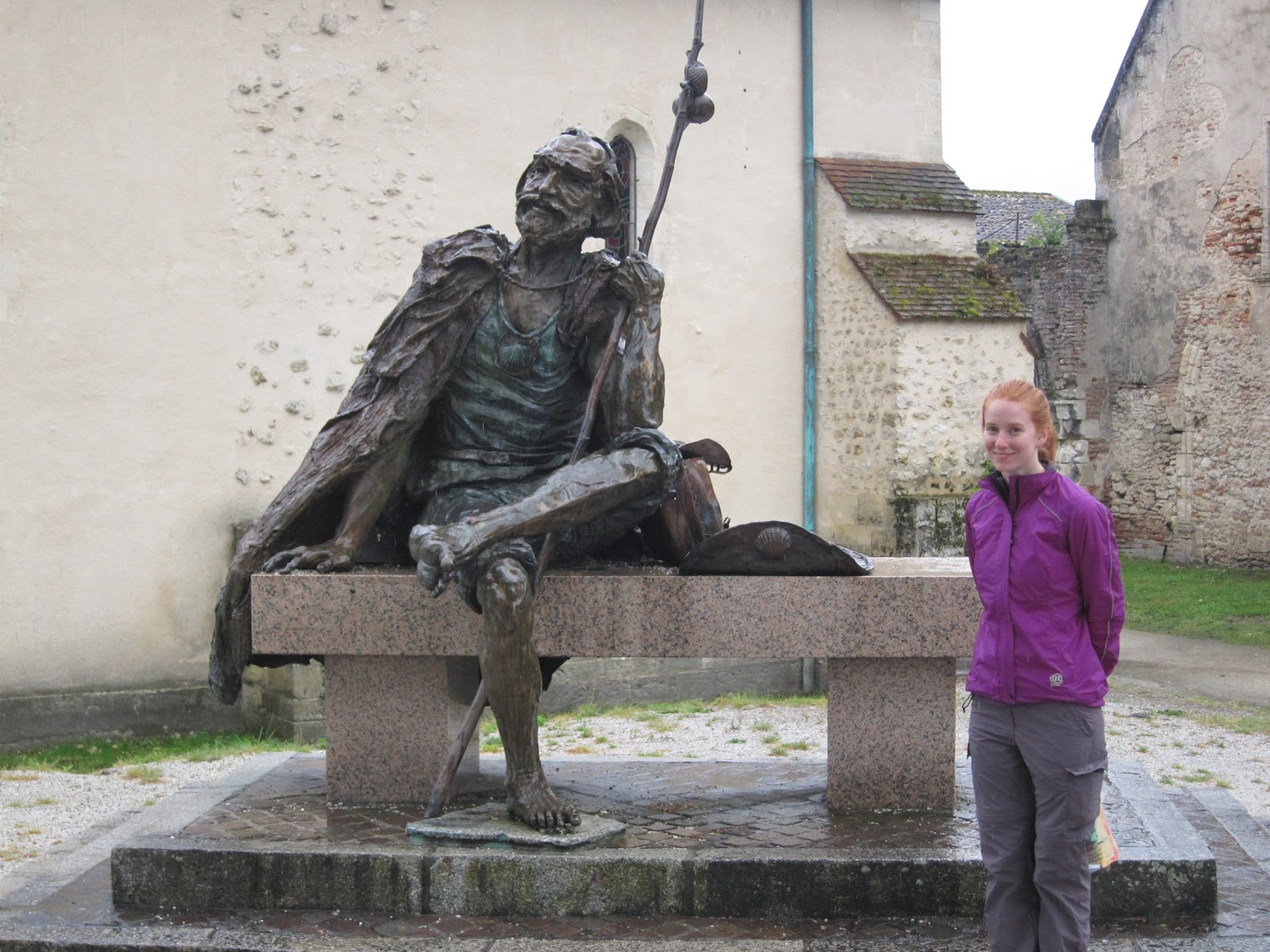
Statue of St James outside the priory
On arrival, we were greeted by two members of the Amis de St Jacques who issued us with a credencial (5 euros) and showed us around the accommodation (10 euros). We had read that this was a donation-based refuge so were surprised at the price - but the place was very clean and nice, and our hosts were extraordinarily kind. They spoke only very basic English but still made the effort to engage with us, and when they were leaving they offered to drive us to the supermarket so that we wouldn't have to walk in the rain (and lent us an umbrella for the way back!). They are volunteers so left to go home at about 6pm - leaving us and our fellow pilgrims with instructions on how to lock up in the morning. When they left they gave us two kisses on the cheek as if they were saying goodbye to good friends.

We shared the refuge with a french couple, Gerard and Maripol, who really only know a few works of English. We managed to get by with hand gestures and a few words of French and English. It helps when there are really only so many things you could be asking about! They were from a small town between Paris and Bordeaux and had already been walking for two weeks when we met them. They had planned for the whole journey to take about 2 months. We each cooked separate meals of pasta, and later they did our dishes as well as their own! I tried to get up from writing in the journal to do some of the cleaning but the woman told me to keep writing. I had seen earlier that she takes her journalling very seriously, so I guess that's why she felt so strongly about it for me.

We headed to bed at about 9pm, tired from our airport adventure the night before and looking forward to what the rest of the trip had in store for us.

The stats for the day:
Odometer: 28.97 km
Moving average: 14.7 kph
Overall average: 10.6 kph
Time on bike: 1h58m
Max speed: 36.4 kph

04 June 2012

We made it!

After 13 days, 1200km, and more feet of climbing than we´d care to count, we reached Santiago de Compostela on Friday 1 June and Cape Finisterre (once believed to be the western-most point in mainland Europe) on Saturday 2 June.

At the Cathedral in Santiago (with our friend Miguel)

Watching the sunset in Cape Finisterre (The end of the Earth)
We´ll get around to posting the details of our journey in due course!